

Cordless Drills & Drivers
Four distinct tools share this category, and the marketing does everything it can to blur them together. A drill/driver, an impact driver, a hammer drill and an impact wrench are different mechanisms solving different problems — and the torque figure printed on each one is the least reliable way to tell them apart.
The four mechanisms
Drill/driver
A rotating chuck with an adjustable clutch. Two speed ranges are typical: roughly 0–500 RPM for driving torque and 0–1,800 RPM or higher for drilling. The clutch collar is the point of the tool — it stops rotation at a set torque so you do not strip a screw head or bury a fastener.
Impact driver
A 1/4 in hex drive with a rotational hammer mechanism firing at roughly 3,000–4,000 IPM under load. Far more fastening torque than a drill/driver of the same voltage, in a shorter, lighter body, with essentially no depth control. No chuck, so round-shank drill bits will not fit.
Hammer drill
A drill/driver with an axial percussion mechanism added — typically 25,000–32,000 BPM. Light, fast hammering suited to masonry anchors in brick and block. It is not an SDS rotary hammer, and expecting it to behave like one is the most common disappointment here.
Impact wrench
A square anvil, usually 1/2 in or 3/8 in, built for nuts and bolts rather than screws. Torque figures here run into the hundreds of Nm, and brands split them into fastening torque and nut-busting torque — two numbers that are not interchangeable.
Reading a torque figure without being misled
Maximum torque is the number every brand leads with and the number that survives cross-brand comparison worst. The reason is that manufacturers do not measure it the same way. A hard-joint measurement drives a fastener against sudden unyielding resistance; a soft-joint measurement lets resistance build gradually as the fastener draws into compressible material. The same tool produces meaningfully different figures under the two conditions, and nothing obliges a manufacturer to state which one appears on the packaging.
Impact drivers and wrenches add another fork: fastening torque and nut-busting torque can differ widely on the same tool, and a brand quoting the larger is not lying, just choosing. Units are a third hazard — 1 Nm is approximately 8.85 in-lbs, and casual rounding between them is a recurring source of published error.
Our position, set out on comparison methodology, is to record the figure with its units and stated conditions intact and treat cross-brand torque as a weak signal. The specifications that survive comparison sit further down the sheet.
| Specification | How comparable across brands | Why |
|---|---|---|
| Max torque (Nm / in-lbs) | Weak | Hard-joint and soft-joint measurement are both permitted and rarely disclosed |
| No-load speed (RPM) | Strong | Measured without load, so the method is effectively fixed |
| Impact rate (BPM / IPM) | Strong | A mechanical property of the mechanism, not a test outcome |
| Chuck capacity | Strong | A physical dimension |
| Bare-tool weight | Strong, if stated bare | Kit weight with a pack fitted is a different figure — check which is quoted |
| Claimed runtime | Very weak | Meaningless unless the pack capacity and load condition are stated |
Brushless, gears and the specifications that actually decide it
A brushless motor removes the friction and wear of carbon brushes and lets the tool’s electronics vary current with load: more work per charge, a cooler tool under sustained use, longer service life. Brushed tools remain reasonable for occasional light use at a lower price tier, but the argument favors brushless as soon as usage rises.
Gear count matters more than most buyers expect. A single-speed drill forces a compromise between the low-speed torque you want for driving and the high speed you want for drilling; a two-speed gearbox gives you both.
Chuck size sets your ceiling: a 10 mm (3/8 in) chuck is compact and adequate for most household work, while 13 mm (1/2 in) accepts larger shanks including spade and auger bits. Dual-sleeve chucks are cheaper; single-sleeve chucks tighten one-handed, which matters more on a ladder than it sounds on paper.
Which should you buy first?
Buying one tool: a two-speed brushless drill/driver — the clutch and chuck make it the only genuinely general-purpose option. Buying two: add an impact driver rather than a hammer drill, because controlled drilling plus high-torque fastening covers far more work than one tool with percussion. Add a hammer drill only if masonry anchors are a regular job, and an impact wrench only for bolted assemblies, vehicles or machinery.
The cost that follows the decision
Every tool here belongs to a battery rail, and buying the first one commits you to it. Drills and impact drivers are the mildest draw of any cordless category, so a pair of 2.0 Ah packs serves them adequately — but they usually arrive first, which means they set the platform your saws and outdoor equipment will later have to live within. Those categories are far hungrier, and by then the brand choice is already made. The five-year arithmetic is on battery platforms.
- Battery Platforms — voltage classes, pack capacity and the lock-in cost that follows this purchase
- Saws — the same rail, under a much heavier current draw
- Measuring & Layout — the tools that decide where the holes go
- Outdoor Power Equipment — where pack capacity stops being optional
See the drill & driver spec comparison — the measured torque, speed and weight distribution across 127 listings, with the fields we removed and why.
Compare them
The finder below is already scoped to this category — 116 of the 433 tools in the corpus. Widen or narrow it from there, or open the full cordless tool finder to search everything at once. Every result is placed against the median weight for its own size class, where that class holds at least eight tools. Weight is the axis because it is the one this category publishes: 340 of 433 tools state it and 65 state a torque figure.
116 tools match

PORTER-CABLE 20V MAX Impact Driver, 1/4 Inch, 2,700 RPM, Battery and Charger Included (PCCK647LB)
Weight
2.13kg
Drills & drivers · 1.5-3 kg · 25 tools
Weight is +7% against the class median of 2.00.

Makita XDT131 18V LXT® Lithium-Ion Brushless Cordless Impact Driver Kit (3.0Ah)
Weight
1.50kg
Drills & drivers · under 1.5 kg · 49 tools
Weight is +120% against the class median of 0.68.

Dewalt DCD794B 20V MAX ATOMIC COMPACT SERIES Brushless Lithium-Ion 1/2 in. Cordless Drill Driver (Tool Only)
Weight
1.13kg
Drills & drivers · under 1.5 kg · 49 tools
Weight is +67% against the class median of 0.68.
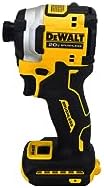
DEWALT DCF850B 20V Cordless Brushless Compact 1/4'' Impact Driver (Tool Only) (DCF850B-NBX)
Weight
1.00kg
Drills & drivers · under 1.5 kg · 49 tools
Weight is +47% against the class median of 0.68.

DEWALT ATOMIC 20V MAX* Impact Driver, Cordless, Compact, 1/4-Inch, Tool Only (DCF809B)
Weight
0.91kg
Drills & drivers · under 1.5 kg · 49 tools
Weight is +33% against the class median of 0.68.

Milwaukee 2656-20 M18 18V 1/4 Inch Lithium Ion Hex Impact Driver with 1,500 Inch Pounds of Torque and LED Lighting Array (Battery Not Included, Power Tool Only)
Weight
0.68kg
Drills & drivers · under 1.5 kg · 49 tools
Weight is 0% against the class median of 0.68.

Makita XDT13Z 18V LXT Lithium-Ion Brushless Cordless Impact Driver, Tool Only, Variable Speed | Tool Only, Variable Speed
Weight
0.45kg
Drills & drivers · under 1.5 kg · 49 tools
Weight is -33% against the class median of 0.68.

DEWALT 20V MAX XR Impact Driver and Hammer Drill Cordless Power Tool Combo Kit, Includes 2 x 4ah POWERPACK Batteries and a Charger (DCK250QQ2)
- Max torque
- 206.197312925Nm
- No-load RPM
- 3400
- Pack
- 4Ah
Weight
4.84kg
Drills & drivers · 3-6 kg · 10 tools
Weight is +21% against the class median of 4.01.

BLACK+DECKER 20V MAX* POWERCONNECT Cordless Drill Driver Kit with Drill Bit Set and Sockets, 100 pc. Tool Kit for Home, Battery and Charger Included, Orange (BDC120VA100)
Weight
2.77kg
Drills & drivers · 1.5-3 kg · 25 tools
Weight is +38% against the class median of 2.00.

COMOWARE Cordless Drill, Electric Power Drill & Bits Set w/Charger& Battery | with 1 Battery & Charger, 3/8" Keyless Chuck, 2 Variable Speed, 266 In-lb Torque, 25+1 Position and 34pcs Power/Driver Bits
Weight
2.36kg
Drills & drivers · 1.5-3 kg · 25 tools
Weight is +18% against the class median of 2.00.

DEWALT 20V MAX XR 1/2 Inch Brushless Cordless Hammer Drill, Battery Not Included (DCD1007B)
- Max torque
- 11.2984829Nm
- No-load RPM
- 0.75
- Pack
- not stated
Weight
2.27kg
Drills & drivers · 1.5-3 kg · 25 tools
Weight is +13% against the class median of 2.00.

AVID POWER 20V Cordless Drill Set for Home DIY & Beginner Projects – Lightweight Power Drill with Battery Charger & 22 Bits, Variable Speed, 3/8" Keyless Chuck, Ideal for Furniture Assembly (Red)
Weight
1.68kg
Drills & drivers · 1.5-3 kg · 25 tools
Weight is -16% against the class median of 2.00.
Common questions
Can an impact driver replace a drill?
Not fully. It takes only 1/4 in hex-shank bits, so round-shank twist drills will not fit, and it has no clutch — depth and torque control are down to your trigger finger. It is superior for driving long fasteners and inferior for precise drilling.
Is 18 V always better than 12 V?
No. Nominal voltage sets the ceiling on power, not the tool’s suitability. A 12 V drill/driver is shorter, lighter and easier to use in a cabinet or a stud bay, and it will drive most household fasteners without complaint. The 18 V class earns its bulk on larger bits, masonry and sustained work.
Why do two drills with the same torque rating feel different?
Because they may not have been measured the same way, and because torque is one input among several. Gear ratios, clutch resolution, chuck runout, weight distribution and the electronics governing current delivery all shape behavior under load, and none appear in the headline figure.
Do you publish star ratings for these tools?
No. We publish specifications and the caveats attached to them. Aggregate ratings compress genuinely different tools into one number and hide the tradeoffs that decide which suits your work.