
Measuring & Layout Tools
This is the one category where manufacturer claims are easy to compare, because accuracy is stated in millimeters and the measurement conditions are normally disclosed. It is also the category most buyers under-invest in, which is odd — a cut is only as good as the line it followed.
The four instrument types
Laser distance meters
Stated accuracy is typically ±1.5 mm to ±3 mm, with range from around 20 m to 100 m or beyond. Accuracy applies under favorable conditions — the caveat is normally stated, and outdoors in bright light both accuracy and usable range fall away.
Line and cross-line lasers
Specified on accuracy per distance — commonly ±0.3 mm/m — self-leveling range (often ±4 degrees), number of lines and planes, and beam color. Green beams are markedly more visible than red but draw more current.
Digital levels and inclinometers
Quoted as accuracy in degrees at level and plumb, often around ±0.05 degrees, with a wider tolerance at intermediate angles. The two-figure specification is the honest one; a blanket accuracy claim quotes only the best case.
Stud and cable detectors
Specified on detection depth by material — wood, metal, live cable — with a different maximum for each. The least standardized specification in the category, and the one where reading the individual depth figures rather than the headline number matters most.
Why accuracy claims here are worth more than torque claims
Elsewhere on this site we spend a lot of time explaining why a published figure resists comparison. Maximum torque, covered on drills and drivers, can be measured under hard-joint or soft-joint conditions with no obligation to say which, so two brands’ figures may not describe the same test.
Measuring tools are different. An accuracy specification of ±0.3 mm/m has a definite meaning: over ten meters the line may deviate by up to three millimeters. Manufacturers here generally state the conditions the figure applies under, because the professional end of the market includes people who will check. That makes cross-brand comparison unusually trustworthy, which is why we treat these specifications as strong signals rather than claims.
| Instrument | Headline specification | The figure people miss |
|---|---|---|
| Laser distance meter | Accuracy in mm, maximum range | Whether the range assumes a target plate, and how it degrades outdoors |
| Cross-line laser | Accuracy in mm/m | Self-leveling range, and behavior when tilted beyond it |
| Rotary laser | Accuracy in mm/m, working diameter | Whether the diameter assumes a detector rather than the naked eye |
| Digital level | Accuracy at level and plumb | The wider tolerance for intermediate angles |
| Stud detector | Maximum detection depth | Depth differs per material; live-cable depth is usually shallowest |
Batteries in a category that barely needs them
Measuring tools are the exception to the platform argument that governs the rest of this site. Most run on AA or AAA cells or a small internal lithium pack, drawing a fraction of what a drill uses, and a set of cells often lasts months of intermittent work. Your battery platform choice — the decision that dictates cost across saws and outdoor equipment — has almost no bearing here.
A few larger instruments, particularly rotary lasers built for site use, do accept platform packs. That is convenient rather than decisive: runtime is generous either way, and buying into a platform for a laser alone would invert the logic. Judge these tools on accuracy, beam visibility and whether the mounting hardware suits your work.
The specification that most often decides day-to-day usability is not accuracy — it is beam visibility. A green cross-line laser is far easier to see in a bright room than a red one at the same power class, and a laser you cannot see is one you stop using.
Calibration, drift and what a specification cannot tell you
Every stated accuracy figure describes the instrument as calibrated. Levels and lasers drift with time, temperature cycling and — mostly — with being dropped. Better instruments state a calibration interval or provide a self-check procedure in the manual, and that provision is worth more than a marginally tighter accuracy figure you have no way to verify.
Two practical checks cost nothing. For a cross-line laser, mark a line, rotate the instrument 180 degrees and see whether it lands on the same mark. For a distance meter, measure a known dimension from both ends and compare. Neither is a calibration; both will reveal an instrument that has gone meaningfully out.
Ingress protection ratings matter more here than in most categories, because these tools get set down on dusty floors and left in vans. An IP rating is standardized and verifiable — one of the few specifications in the cordless world with an independent standard behind it, as noted on comparison methodology.
What to buy, in what order
For interior work — hanging, tiling, shelving, kitchen fitting — a self-leveling cross-line laser is the most useful single purchase, and a green beam is worth the current it costs. For estimating and any work involving room dimensions, a laser distance meter pays for itself in the first afternoon of not holding one end of a tape. Buy a rotary laser only when setting levels across a site, and treat a stud detector as a supplement to knocking and looking, never a substitute for care around cables.
- Drills & Drivers — where your marks get drilled
- Saws — layout accuracy determines cut accuracy
- Battery Platforms — the decision this category is exempt from
- Outdoor Power Equipment — the far end of the platform
Compare them
The finder below is already scoped to this category — 60 of the 433 tools in the corpus. Widen or narrow it from there, or open the full cordless tool finder to search everything at once. Every result is placed against the median weight for its own size class, where that class holds at least eight tools. Almost everything here falls in the lightest band, so weight separates these instruments less than it does the rest of the site.
60 tools match

BOSCH GLL50-20G 50 Ft Green-Beam Self-Leveling Cross-Line Laser, Includes Integrated Magnetic Mount, 2 AA Batteries, & Soft Pouch
Weight
0.35kg
Measuring & layout · under 1.5 kg · 36 tools
Weight is +79% against the class median of 0.20.

DEWALT Laser Level 360 Self Leveling, 3 Way Green Laser Leveler Tool 12V MAX with 2.0Ah Battery, Charger and Durable Carrying Case, 100 Ft, Tripod Compatible (DW089LG)
Weight
3.74kg
Too few tools in this class to publish a baseline.

DTAPE 165 Ft Laser Measuring Tool, 1/16" High-Accuracy Laser Tape Measure | 2" Backlit LCD Display Laser Measure, Ft/In/Ft+In/M Electronic Tape Measure, Distance/Area/Volume/Indirect Laser Range Finder
Weight
0.21kg
Measuring & layout · under 1.5 kg · 36 tools
Weight is +8% against the class median of 0.20.

165ft/50m Laser Measure Ft/in/M Switching LM50 Laser Measurement Tool Devices with 2 Bubble Levels Distance Meter,Large Backlit LCD
Weight
0.20kg
Measuring & layout · under 1.5 kg · 36 tools
Weight is +3% against the class median of 0.20.

Laser Measuring Tool, RockSeed Portable Laser Measure, Digital Distance Measurement with 2 Bubble Levels, Laser Tape Measure with 5 Units Conversion
Weight
0.15kg
Measuring & layout · under 1.5 kg · 36 tools
Weight is -23% against the class median of 0.20.

Laser Measuring Tool, RockSeed Portable Laser Measure, Digital Distance Measurement with 2 Bubble Levels, Laser Tape Measure with 5 Units Conversion
Weight
0.15kg
Measuring & layout · under 1.5 kg · 36 tools
Weight is -26% against the class median of 0.20.

Laser Measure,RockSeed Digital Laser Distance Meter with 2 Bubble Levels,Portable M/in/Ft Unit Switching Backlit LCD and Measuring Distance/Area/Volume/Pythagorean
Weight
0.12kg
Measuring & layout · under 1.5 kg · 36 tools
Weight is -38% against the class median of 0.20.

Laser Measure,RockSeed Digital Laser Distance Meter with 2 Bubble Levels,Portable M/in/Ft Unit Switching Backlit LCD and Measuring Distance/Area/Volume/Pythagorean
Weight
0.12kg
Measuring & layout · under 1.5 kg · 36 tools
Weight is -38% against the class median of 0.20.

BOSCH GLM100-23 100ft Laser Measure with Backlit Display, Blue
Weight
0.09kg
Measuring & layout · under 1.5 kg · 36 tools
Weight is -56% against the class median of 0.20.

BOSCH GLM165-27CGL 165 Ft Blaze Green-Beam Laser Distance Measure with 3.7V Lithium-Ion 1.0 Ah Battery, Includes 1.0 Ah 3.7V Lithium-Ion Battery, Belt Clip, & Pouch
Weight
Not stated
This listing does not publish a figure, so it cannot be placed against the baseline.
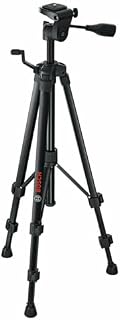
BOSCH BT 150 Compact Tripod with Extendable Height for Use with Line Lasers, Point Lasers, and Laser Distance Measures
Weight
1.32kg
Measuring & layout · under 1.5 kg · 36 tools
Weight is +574% against the class median of 0.20.

DEWALT Line Laser, Self-Leveling, Cross Line, Red Beam (DW088K)
Weight
0.60kg
Measuring & layout · under 1.5 kg · 36 tools
Weight is +208% against the class median of 0.20.
Common questions
Is a green laser worth the extra over a red one?
For indoor work in daylight, usually yes — the eye is substantially more sensitive to green at the wavelengths used, so the line reads brighter at the same output. The cost is higher current draw. Outdoors, neither color is reliably visible and a detector is the real answer.
What does ±0.3 mm/m actually mean on site?
That the line may deviate by up to 0.3 mm per meter of distance from the instrument: 3 mm at ten meters. Whether that is acceptable depends on the work — negligible for a row of shelves, significant when setting a long floor level.
Can a stud detector be trusted around cables?
Treat it as one input among several, never as proof. Detection depth differs by material and the live-cable figure is typically the shallowest. Isolate the circuit before drilling into a wall you cannot see inside.
Do you test the accuracy of these instruments?
No. We record the stated accuracy, the conditions it applies under and any calibration provision in the documentation. Where a claim is published without conditions, we note the omission rather than repeat it as fact.