

Battery Platform Spec Comparison
The measured baseline for cordless tool batteries and chargers across 62 listings — pack voltage, capacity and weight. An earlier version of this page could not publish a capacity figure at all; at double the sample it can, and the reason why is worth reading before you trust the number.
Why this page now publishes a capacity figure
The useful measure of a battery pack is energy: voltage multiplied by capacity. A 20 V 4.0 Ah pack holds 80 watt-hours, and watt-hours per kilogram is the right way to compare packs across voltage classes.
We could not compute it at the previous sample size, and the change is instructive. Some listings in this category state capacity in milliamp-hours in a field recording amp-hours — a thousandfold error — and one records a pack as 2000Ah. Those records still exist. What changed is their share: at 22 listings they were 23% of the field, above our 20% contamination limit, so the whole field was withheld. At 62 listings the same handful of bad records is 18%, and the field clears.
The contaminated values are excluded from every figure below either way — the quartiles are computed over surviving values only. The gate decides whether we trust the field enough to publish at all, and that judgement is a proportion, so it moved when the denominator did.
This is worth stating plainly rather than quietly publishing a number that was absent last month. A threshold crossed by dilution is a weaker result than a threshold crossed by better data, and you should discount the capacity row accordingly.
The category baseline
62 listings, of which the following carried usable data.
| Specification | Products with data | Coverage | P25 | Median | P75 |
|---|---|---|---|---|---|
| Pack voltage (V) | 58 | 94% | 13.5 | 20 | 20 |
| Pack weight (kg) | 54 | 87% | 0.35 | 0.82 | 2.14 |
| Pack capacity (Ah) † | 28 | 45% | 1.88 | 2.5 | 4.0 |
† Read the capacity row with the caveat above in mind: it clears our contamination limit at 18%, having been withheld at 23% on a smaller sample.
Voltage is the best-covered specification anywhere on this site at 94%, which makes sense — it is the field a pack is sold on, and a pack that does not state its voltage is unsellable. The distribution is tight: half the category sits at 20 V nominal, the 25th percentile at 13.5 V, and the full range runs from a 3.7 V single cell to a 56 V outdoor-equipment pack.
Pack weight spreads much wider — 0.35 kg at P25 against 2.14 kg at P75, a factor of six. Within a voltage class pack mass tracks cell count and cell count tracks capacity, so weight remains a usable cross-check on the capacity row rather than a substitute for it.
The energy figure, at last
Multiplying the medians gives the number this page previously could not state: a 20 V marked pack is 18 V nominal, and 18 V × 2.5 Ah is 45 watt-hours for the median pack. At the quartiles it runs from about 34 Wh (13.5 V marked, 1.88 Ah) to about 72 Wh (20 V marked, 4.0 Ah).
Against the median pack weight of 0.82 kg that is roughly 55 watt-hours per kilogram. Treat this as an order-of-magnitude figure rather than a precise one: it divides quartile by quartile across two fields with different coverage, and the capacity field is the least reliable on the page.
The voltage classes, and what “MAX” means
Voltage labelling in this category is the most consistently misleading thing on a tool shelf, and it is not the retailers’ doing.
A lithium cell measures about 4.0 V fully charged and settles to about 3.6 V nominal under load. Five cells in series therefore read 20 V off the charger and 18 V nominal. Both numbers describe the same pack. A brand printing “20V MAX” and a brand printing “18V” may be selling identical electronics, and the one with the bigger number on it is not more powerful.
| Marked | Nominal | Cells in series | Where it sits in this category |
|---|---|---|---|
| 12V MAX | 10.8 V | 3 | The P25. Compact drivers, precision work |
| 20V MAX | 18 V | 5 | The median. The main line of drills, drivers, saws and small outdoor tools |
| 40V / 40V MAX | 36 V | 10 | Mowers and larger outdoor equipment |
| 60V MAX | 54–56 V | 15 | The top of this sample. Heavy outdoor equipment |
Compare nominal against nominal, or marked against marked, and never one against the other. The voltage and amp-hours guide works through why voltage on its own tells you so little, and why capacity rather than voltage is the figure that predicts how long you will be working.
The exclusions you should know about
Two fields appeared in this category and were removed as artefacts rather than specifications. Torque and speed figures both appear on a minority of listings — both below the coverage threshold, and both describing the tools sold in kits alongside the packs rather than the packs themselves. A battery does not have a torque rating. Their presence is a shortlisting artefact, and carrying them would have implied a property the product does not possess.
Charger output current, charge time and cycle life are absent from this corpus entirely. All three are decision-relevant and none are published as structured specifications at any usable rate.
What to do with this
Read voltage as a compatibility fact rather than a performance one — it tells you which tools a pack will fit and nothing about how long it will run them. Get the capacity figure from the manufacturer’s own page, confirm whether it is stated in Ah or mAh before you compare two packs, and multiply it by nominal voltage to get watt-hours if you want a number that means something across brands.
Then read battery platforms for the part that outlasts any individual pack: the platform you commit to with your first tool is the one your fifth tool has to live within.
Nothing above is a recommendation, a ranking or a test result. We do not own these packs. The method, including the coverage threshold and the unit check, is on comparison methodology.
The Products These Figures Come From
Of the 62 packs in this category, 29 publish every figure in the baseline above. The 10 shown here are listed by price tier, then alphabetically — this is not a ranking, and a product appearing here means its listing is complete, nothing more. 10 listings are held back for a published figure far outside the category’s own range — a data defect rather than an unusual product.
| Product | Brand | Price Tier | Pack voltage (V) | Weight (kg) | Pack capacity (Ah) | Key Details |
|---|---|---|---|---|---|---|
 DEKOPRO Power Drill Cordless |
DEKOPRO | <$30 | 20 | 1.13 | 1.5 | 18+1 torque settings, two speeds to 1350 rpm; 1.5 Ah pack and charger; 2.5 pounds |
 Makita DC18RC 18V LXT® Lithium-Ion Rapid Optimum Charger |
Makita | <$30 | 18 | 0.83 | 3.0 | A charger, not a pack: 30 minutes for a 3.0Ah 18V LXT cell, 45 minutes for a 5.0Ah |
 Milwaukee 48-59-2401 12V Lithium-Ion Battery Charger |
Milwaukee | <$30 | 12 | 0.45 | 3.0 | A charger, not a pack: 12V lithium-ion, stated 30-minute charge |
 AOBEN Cordless Angle Grinder 4-1/2 inch |
AOBEN | $30-75 | 21 | 4.82 | 4.0 | An angle grinder kit, not a bare pack: brushless motor, 3 speeds to 9500 RPM, two 4.0Ah packs |
 Biswaye 2 Pack 20V Lithium Battery Compatible with Porter… |
Biswaye | $30-75 | 20 | 0.18 | 3.0 | Third-party pack for Porter-Cable 20V tools; rated for about 500 charges; protection microchip |
 BLACK+DECKER 20V MAX Lithium Battery POWERCONNECT 2.0Ah… |
BLACK+DECKER | $30-75 | 20 | 0.40 | 2.0 | Fits the BLACK+DECKER 20V MAX Powerconnect range; monitors voltage and temperature |
 BLACK+DECKER 20V MAX* POWERCONNECT 1.5Ah Lithium Ion… |
BLACK+DECKER | $30-75 | 20 | 0.59 | 1.5 | Pack and charger together for the 20V MAX Powerconnect range; self-regulating protection |
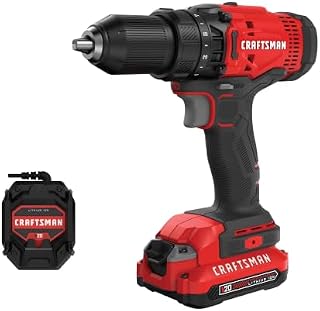 CRAFTSMAN V20 Cordless Drill/Driver Kit |
CRAFTSMAN | $75-200 | 20 | 1.97 | 1.3 | A drill kit, not a bare pack: 1/2 inch keyless chuck, two-speed gearbox, LED work light |
 CRAFTSMAN V20 MAX Cordless Drill Driver and Impact Driver… |
CRAFTSMAN | $75-200 | 20 | 3.81 | 2.0 | A two-tool kit: 280 UWO drill driver plus an impact driver rated 2,800 RPM |
 DEWALT 20V MAX 5 Ah Lithium-Ion Battery and Charger Starter… |
DEWALT | $75-200 | 20 | 0.64 | 5.0 | Pack and charger; 3-LED fuel gauge; 1.4 lb pack across the 20V MAX line |
Key Details summarize what each listing states about itself, in our words rather than the seller’s. Every claim is checked against the listing text it was taken from.
Notes on the Products at the Edges
Most of the products above sit inside the interquartile range on every figure, which is what the baseline already describes. These are the ones it does not: each is outside P25 or P75 on at least one published figure. The position is computed from the category statistics; the explanation is what the listing itself states.
AOBEN Cordless Angle Grinder 4-1/2 inch — AOBEN, $30-75
Weight of 4.82 kg sits above the category P75 of 2.14 kg. Not a bare pack: an angle grinder kit supplied with two 21V 4.0Ah batteries, so the figure covers the whole box.
CRAFTSMAN V20 MAX Cordless Drill Driver and Impact Driver… — CRAFTSMAN, $75-200
Weight of 3.81 kg sits above the category P75 of 2.14 kg. Two tools and their packs rather than a battery: a 280 uwo drill driver plus an impact rated 1,460 in-lbs.
Specifications are the manufacturer’s published values as scraped for this corpus, not our own measurements — the same source, and the same limits, as the baseline above. Prices move daily, so we show the tier rather than an amount. Links to Amazon are affiliate links.
Common questions
Why is the capacity figure caveated?
Because some listings state milliamp-hours in a field recording amp-hours — a thousandfold error — and those records still exist. They are excluded from the quartiles, but their share of the field is what decides whether we publish it at all, and that share fell below our limit because the sample grew rather than because the data improved.
Is 20V MAX better than 18V?
They are usually the same pack. 20 V is the charged-off-the-charger measurement and 18 V is the nominal measurement of five lithium cells in series. The difference is which convention the brand prints.
Does a heavier pack hold more energy?
Within one voltage class, broadly yes — mass tracks cell count and cell count tracks capacity. Across voltage classes it breaks down. It is a useful cross-check on a stated capacity, not a replacement for one.
Do you rank battery platforms or pick a winner?
No. This page is a distribution and a set of definitions, not a leaderboard. The right platform depends on which tools you already own, which is not something a category average can answer.