

Cordless Saw Spec Comparison
The measured baseline for cordless circular saws — blade diameter, no-load speed and bare weight across 60 listings — and the finding that matters more than any of them: the median saw in this category is a 4-inch compact, not the 7¼-inch standard most buyers picture when they search for one.
The category baseline
60 listings, of which the following carried usable data.
| Specification | Products with data | Coverage | P25 | Median | P75 |
|---|---|---|---|---|---|
| Bare weight (kg) | 50 | 83% | 2.10 | 3.22 | 4.18 |
| Blade diameter (mm) | 38 | 63% | 101.6 | 101.6 | 161.9 |
| No-load speed (RPM) | 44 | 73% | 3,850 | 4,700 | 5,300 |
The category is not the one the search term implies
Both the 25th percentile and the median blade diameter are 101.6 mm — 4 inches. The 75th percentile is 161.9 mm, or about 6⅜ inches. The largest blade in the entire sample is 203 mm — 8 inches — and the familiar 7¼-inch framing size sits near the top of the distribution rather than in the middle of it.
That is a statement about what this category sells, not about what a circular saw is. Search “cordless circular saw” and the results are dominated by compact and mini saws — single-handed tools with 4-inch blades intended for sheet goods, trim and plunge cuts. The full-size framing saw exists in the category but is outnumbered.
Why this matters before you compare anything else: blade diameter sets maximum depth of cut, and depth of cut is what decides whether a saw can do the job at all. A 4-inch blade cuts roughly 25 mm at 90°, which will not pass through a 2×4 in a single pass. If dimensional lumber is the work, the median figure in the table above is not your benchmark — the top of the distribution is, and you should filter to 165 mm blades or larger before reading any other specification.
The weight column reads consistently with that. A median of 3.22 kg is light for a framing saw and heavy for a mini saw, because the sample contains both. The interquartile range, 2.10 to 4.18 kg, is where the compact saws cluster.
The exclusion you should know about
Every figure above survived a unit check: we read the original text each number was extracted from and confirmed the unit was one the field can legitimately hold. One field in this category failed.
Pack voltage (V) — removed. Only a portion of the voltage figures in this category are a battery platform voltage. The rest are mains voltage — 120 volts and one 220 volts_of_alternating_current — because 35% of this category is corded rather than cordless, and a corded saw’s supply voltage lands in the same specification slot as a cordless saw’s pack voltage. Averaging the two produces a “typical voltage” for the category that describes no tool in it. We removed the field rather than publish that.
This is worth carrying to other categories: any specification field that both corded and cordless tools populate is a mixed population by default, and a category average over it is meaningless unless the two are separated first.
Reading the speed figure
No-load speed is one of the more comparable specifications in cordless tools, because it is measured without load and the method is therefore effectively fixed. The interquartile range here, 3,850 to 5,300 RPM, is narrow, which is what you would expect from a mechanically constrained figure.
One caveat on the extremes: the maximum in this sample is 22,000 RPM, which is a rotary-tool figure rather than a circular-saw one and reflects a listing whose category assignment we would not defend. The quartiles are unaffected — that is the reason this page quotes medians and quartiles rather than means and maxima throughout.
Blade speed at the rim, not spindle speed, is what governs cut quality, and rim speed depends on diameter as well as RPM. A 4-inch blade at 5,000 RPM and a 7¼-inch blade at 5,000 RPM are not doing the same thing to the workpiece.
How to place a saw against this
| Blade diameter | What it can do |
|---|---|
| ~102 mm (4 in) | The category median. Sheet goods, plywood, trim, plunge cuts. Roughly 25 mm depth at 90° — will not cross-cut framing lumber in one pass |
| ~162 mm (6⅜ in) | The P75. Handles most 1× stock and thin sheet material comfortably; still short of a 2× in one pass on many models |
| 165–184 mm (6½–7¼ in) | Full-size framing class. The top of this sample rather than its middle. This is where depth of cut passes 2× lumber at 90° and usually at 45° |
Check depth of cut at 45° as well as at 90°. Bevel capacity falls away faster than most buyers expect, and it is the figure that decides whether a saw can do rafter and stringer work.
The Products These Figures Come From
Of the 60 saws in this category, 29 publish every figure in the baseline above. All 10 are listed by price tier, then alphabetically — this is not a ranking, and a product appearing here means its listing is complete, nothing more. 4 listings are held back for a published figure far outside the category’s own range — a data defect rather than an unusual product. 15 are held back because the listing’s own title contradicts the specification field we would have printed. 1 is excluded for a specification we have confirmed to be wrong.
| Product | Brand | Price Tier | Blade diameter (mm) | No-load speed (RPM) | Weight (kg) | Key Details |
|---|---|---|---|---|---|---|
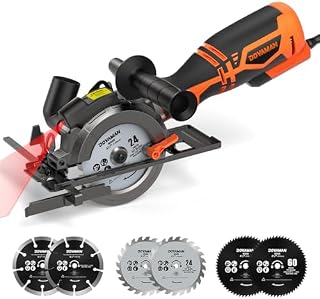 DOVAMAN Circular Saw |
DOVAMAN | $30-75 | 114 | 3,700 | 1.77 | Metal · 220 volts_of_alternating_current · 45 degrees |
 G LAXIA 4A Mini Circular Saw Corded with Laser Guide |
G LAXIA | $30-75 | 114 | 3,500 | 2.72 | Wood · 120 volts · 45 degrees |
 GALAX PRO DC20V 4-1/2" Cordless Mini Circular Saw with… |
GALAX PRO | $30-75 | 114 | 3,400 | 2.86 | Tile · 20 volts · 90 degrees |
 Ryobi One P505 18V Lithium Ion Cordless 5 1/2" 4 |
RYOBI | $30-75 | 140 | 4,700 | 1.86 | Wood · 18 volts · 50 degrees |
| RYOBI ONEAND 18V Cordless 5 1/2 in. Circular Saw Tool ONLY |
RYOBI | $30-75 | 140 | 4,700 | 2.04 | Wood · 18 volts · 45 degrees |
 BOSCH CCS180B 18V 6-1/2 In. Blade Left Circular Saw (Bare… |
Bosch | $75-200 | 165 | 3,900 | 2.99 | Wood · 18 volts · 90 degrees |
 DEWALT 20V MAX Circular Saw |
DEWALT | $75-200 | 165 | 5,100 | 3.16 | Wood · 20 volts · 50 degrees |
 Makita XSS02Z 18V LXT Lithium-Ion Cordless 6-1/2" Circular… |
Makita | $75-200 | 165 | 3,700 | 1.50 | Wood · 18 volts · 45 degrees |
 DEWALT 20V MAX 6-1/2-Inch Circular Saw Kit |
DEWALT | $200-500 | 165 | 5,150 | 4.08 | Wood · 20 volts · 50 degrees |
 Makita XSR01Z 36V (18V X2) LXT® Brushless Rear Handle… |
Makita | $200-500 | 184 | 5,100 | 5.49 | surface_recommendation · 36 volts · 90 degrees |
Key Details are the listing’s own structured specification rows — surface recommendation, voltage, cutting angle — reproduced as published.
Notes on the Products at the Edges
Most of the products above sit inside the interquartile range on every figure, which is what the baseline already describes. These are the ones it does not: each is outside P25 or P75 on at least one published figure. The position is computed from the category statistics; the explanation is what the listing itself states.
Makita XSR01Z 36V (18V X2) LXT® Brushless Rear Handle… — Makita, $200-500
Weight of 5.49 kg sits above the category P75 of 4.15 kg. A rear-handle saw run from two LXT batteries, which is where the mass sits; the motor is rated 5,100 RPM.
Makita XSS02Z 18V LXT Lithium-Ion Cordless 6-1/2" Circular… — Makita, $75-200
Weight of 1.50 kg sits below the category P25 of 2.06 kg. Weighed as a bare tool — the listing quotes 7.3 lbs with a battery, which is not included — at 3,700 RPM with a 2-1/4” cut at 90°.
Specifications are the manufacturer’s published values as scraped for this corpus, not our own measurements — the same source, and the same limits, as the baseline above. Prices move daily, so we show the tier rather than an amount. Links to Amazon are affiliate links.
What this category does not publish
Brushless construction, torque and pack capacity all appear on a minority of listings, none reaching a usable sample, so none appear above. Depth of cut, which is the single most decision-relevant figure in the category, is almost never carried as a structured specification and has to be read from the manufacturer’s page. Arbor size is similarly absent, and it determines which blades will fit.
Nothing above is a recommendation, a ranking or a test result. We do not own these tools. The method, including the coverage threshold and the unit check, is on comparison methodology.
Common questions
Why is the median blade only 4 inches?
Because compact and mini circular saws outnumber full-size ones in this category. It reflects what is sold under the term, not what a circular saw is. If you need to cut framing lumber, read the top of the distribution rather than its middle.
Can a 4-inch compact saw cut a 2×4?
Not in a single pass at 90°. Depth of cut on a 4-inch blade is roughly 25 mm and a 2×4 is around 38 mm thick. Cutting from both sides is possible and is a worse joint than one pass with the right saw.
Why did you drop the voltage column here but keep it elsewhere?
Because this category is 35% corded, so the field mixes mains supply voltage with battery pack voltage. In the drill and battery categories the corded share is small enough that the field remains a single population. The test is applied per category rather than site-wide for exactly that reason.
Do you rank these saws or pick a winner?
No. This page is a distribution, not a leaderboard. It exists so you can place a specific saw against its category before deciding.